
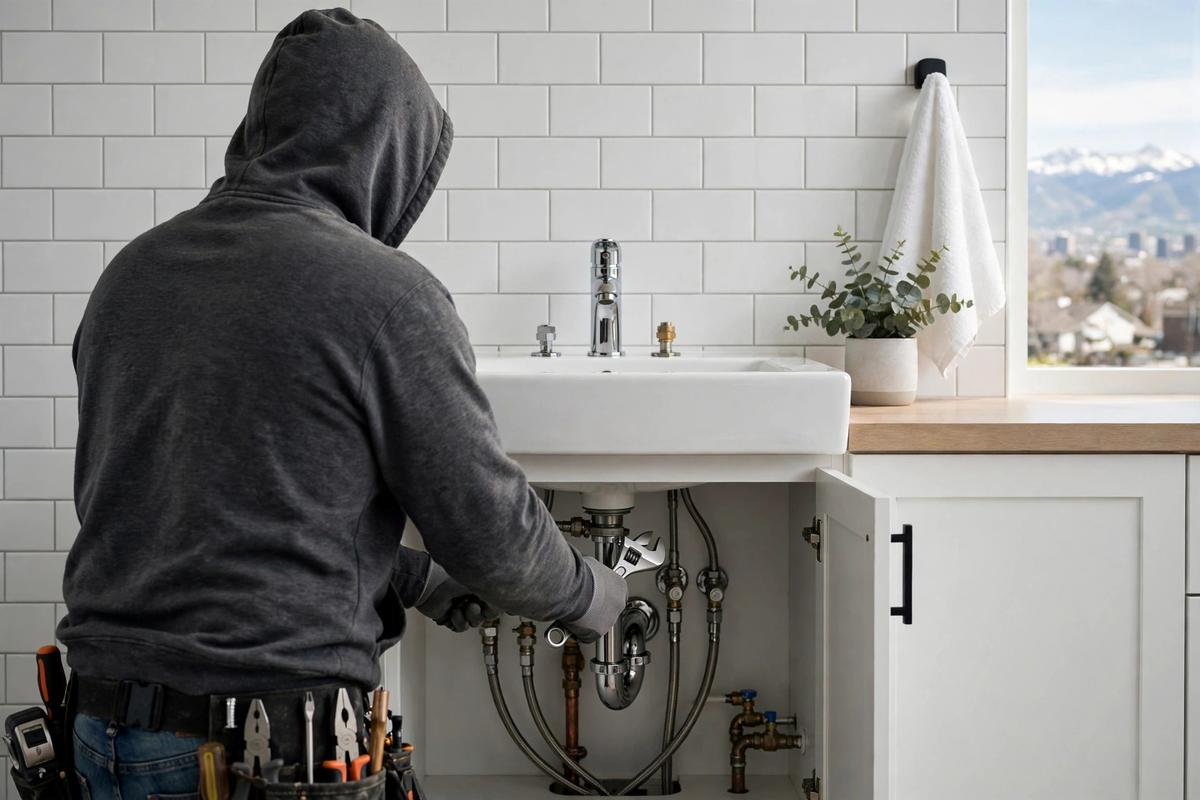
Replacing a bathroom faucet is a straightforward job on a newer home, and a job that can surprise you on an older Denver home, where the shutoff valve may not turn and the supply line may be brittle. This guide walks through the steps and flags the older-home traps.
Before you start
Check the shutoffs actually turn
Turn off the water at the shutoffs under the sink and open the faucet to drain the lines. Put a bucket and towels under the trap. Check that the shutoffs actually turn: on older Denver homes the brass shutoff can be frozen in place, and forcing it can break the valve or the supply line. If a shutoff will not turn, or it leaks when you touch it, stop and call a plumber.
Remove the old faucet
Disconnect the supply lines from the faucet tails, noting which is hot and which is cold. Unscrew the mounting nuts under the sink, a basin wrench helps in the tight space, and lift the old faucet out. Clean the sink surface and remove old putty or sealant. If the old faucet has been in place for decades, the nuts may be corroded: penetrating oil and patience beat force.
Fit the new faucet
Check the hole spacing on your sink before you buy: 4-inch centreset and 8-inch widespread are not interchangeable without an adapter plate. Set the new faucet in place with its gasket or a bead of sealant, tighten the mounting nuts evenly from below, and connect the supply lines. Use new supply lines rather than reusing old ones, especially braided lines of unknown age.
Test for leaks
Run both hot and cold
Turn the water back on slowly and check every connection: supply lines, mounting nuts and the drain. Run both hot and cold, and check again after a few minutes. A slow drip at a supply connection usually means the connection needs a quarter turn, or the washer needs replacing. Check under the sink again the next day.
Denver older-home notes
In pre-1960 Denver homes, expect galvanized supply pipe, a frozen shutoff, or a brittle supply line. In a converted Capitol Hill or Baker apartment, the faucet may share a stack with the unit below, so a leak shows up downstairs. If the job turns into a shutoff replacement or a supply-line repair, see faucet repair and faucet installation, or call (720) 599-7253.